Glass rarely breaks the way people expect it to. No slow-motion moment. No warning creak. No dramatic crack down the middle while the whole family gasps in the doorway. That’s the version from movies, and glass has never seen a movie.
Real shower glass damage is quieter, and a little sneaky about it. It shows up as a cloudiness you blame on the lighting. A scratch you’re pretty sure wasn’t there last week. A chip so small you decide you imagined it, because imagining it is easier than thinking about it. And it all arrives so gradually that you stop noticing — the way you stop hearing a clock in a room you’ve sat in long enough.
Then one morning the sun comes through the window at exactly the wrong angle, and the enclosure that used to disappear into the bathroom is suddenly just… there. Tired. Cloudy in a way no squeegee is going to fix.
Here’s the reassuring part. Tempered shower glass is genuinely tough. It handles daily use, temperature swings, steam, and the occasional half-asleep elbow far better than most things in the room. But tough and invincible were never the same word, and the things that actually wear glass down are almost never the things people lie awake worrying about. Nobody’s shower door gives out because someone glared at it.
It’s the small, daily, forgettable stuff. The stuff that never feels like a problem until, all at once, it is.
Key Takeaways
- Most shower glass damage is gradual — hard water, coating wear, and hardware stress do more harm over time than any single dramatic event.
- Etching from minerals and harsh cleaners is permanent; unlike surface haze, it can’t be cleaned off once it’s set in.
- The hardware fails before the glass does — hinges, seals, and brackets are wear parts with predictable lifespans.
- An edge chip or built-in installation stress can raise the risk of breakage later, which is why a failure can seem to come out of nowhere.
- Most of what looks alarming is cleanable or adjustable; genuine damage is narrower and best confirmed by a professional.
Hard Water: The Slow Vandal
Every shower leaves something behind. The water evaporates, disappears completely, and seems to take everything with it. It doesn’t. It leaves minerals — calcium, magnesium, the invisible residents of New York tap water — scattered across the glass in amounts too small to see.
One shower is nothing. A week is nothing. But minerals keep excellent records.
Left alone, those deposits build into a haze that looks like the glass is dirty. At first it is. A good clean brings it back. Ignore it long enough, though, and the minerals stop sitting on the surface and start etching into it — a microscopic roughening that scatters light and never fully wipes away. That cloudiness becomes part of the glass instead of something resting on top of it.
This is the single most common form of shower glass damage in the Bronx, and the most preventable. The fix is boring and it works: a quick wipe after showering, before the water gets a chance to settle. We go deeper on the routine in our guide to keeping a frameless enclosure spotless.
Harsh Cleaners and Sharp Objects
Somewhere along the way, cleaning became a contest of force. If a little cleaner works, more must work better, and if the cleaner won’t do it, surely a razor blade will.
Glass disagrees.
Abrasive powders, steel wool, scouring pads, and harsh chemicals can damage protective coatings and leave scratches or dull spots on the glass. The damage doesn’t show up immediately. It shows up three months later as a patch that catches the light differently than the glass around it, and by then there’s no cleaner in the cabinet that will bring it back.
Razor blades and metal scrapers deserve their own warning. They feel productive. They feel like they’re really getting in there. They are also the fastest way to put a permanent scratch across a panel you’ll be looking at every day for the next fifteen years.
Gentle and consistent beats aggressive and occasional, every time.
Impact and Edge Chips
Tempered glass has a strange relationship with force. Across its face, it’s remarkably strong — you can lean on it, bump it, and it shrugs. Its edges and corners are a different story.
A shampoo bottle knocked off a shelf. A cleaning tool dropped in the wrong spot. A frame catching the edge of the door as it swings. These small impacts rarely break anything on the spot, but they can leave a tiny chip at the edge — and a chip is where trouble starts.
An edge chip can compromise the glass and increase the risk of breakage later. It often doesn’t cause any immediate failure, which is exactly why a small chip can seem unrelated when the glass eventually gives out — the two events are far enough apart that nobody connects them. It looks spontaneous. It rarely is.
This is one reason installation and glass thickness matter so much — a panel specified correctly for its size and handled properly has far fewer weak points to begin with.
Improper Installation and Stress
Some shower glass is compromised before anyone’s taken a single shower behind it.
Tempered glass holds itself together under carefully balanced internal tension, and that balance doesn’t like being fought. A panel forced into an opening that isn’t square. Hardware over-tightened against the glass. Hinges anchored a little off, so the door hangs with a permanent, low-level strain it was never meant to carry. None of it announces itself. The door closes, the glass looks fine, everyone moves on.
But built-in stress is patient. A panel carrying it can go months or years without complaint and then fail in a way that looks completely random — no impact, no obvious cause, just a door that let go on an ordinary Tuesday. Those are the failures people find hardest to believe, precisely because nothing “happened.” Something did. It happened at installation.
This is the quiet argument for getting the measurement and the fit right the first time, with hardware matched to the glass and an opening measured for what it actually is rather than what it’s assumed to be. Glass that’s installed correctly for the space — uneven walls and all — starts its life without a stress it will otherwise carry for years.
Hardware Stress and Wear
The glass gets all the attention. The hardware does all the work.
Every hinge carries real weight, all day, every day, without complaint. Seals flex thousands of times. Brackets hold their position against the small constant forces of a door opening and closing. None of it lasts forever, and none of it is supposed to.
The problem starts when worn hardware goes unnoticed. A hinge that’s loosened slightly changes how the door hangs, which changes where the stress lands on the glass. A door that’s dropped even a few millimeters can start catching, and catching means force in places the glass wasn’t meant to absorb. Over time, that misalignment does more damage than any single impact.
Most of it is fixable, and cheaply, if it’s caught early. A hinge adjustment. A replaced gasket. The kind of thing that takes a professional twenty minutes and prevents a conversation about replacing the whole panel later.
Coating Wear
Many frameless enclosures come with a factory-applied coating — the treatment that makes water bead up and slide off instead of settling in. It’s genuinely useful, and it’s also frequently misunderstood.
A coating is not a force field. It doesn’t stop damage; it delays the maintenance. And it wears — faster in the spots that get touched and rubbed most, around the handle, at the corner where someone always leans, below the showerhead where the water hits hardest.
As the coating thins, those areas start showing water spots sooner than the rest of the panel. That’s not the glass failing. It’s the coating doing exactly what coatings do, which is wear out gradually and quietly. Depending on the product, it may be possible to reapply a protective coating. What no coating can do is turn glass into something that never needs cleaning, no matter what the bottle promised.
When Damage Means Repair — and When It Means Replacement
Not everything that looks like damage is permanent, and not everything permanent needs a new panel.
Surface haze, water spots, and soap film are almost always recoverable — that’s cleaning, not damage. A worn coating can be refreshed. Loose or tired hardware can be adjusted or swapped. These are the small, cheap fixes, and they cover most of what homeowners panic about.
Real damage is narrower than people think. Deep etching that’s set into the glass. A chip or crack at the edge. A deep scratch that catches a fingernail. These don’t rinse out with ordinary cleaning, and depending on the depth, location, size, and the glass itself, they either warrant keeping an eye on or a professional assessment — the fingernail test tells you it’s real, not what to do about it.
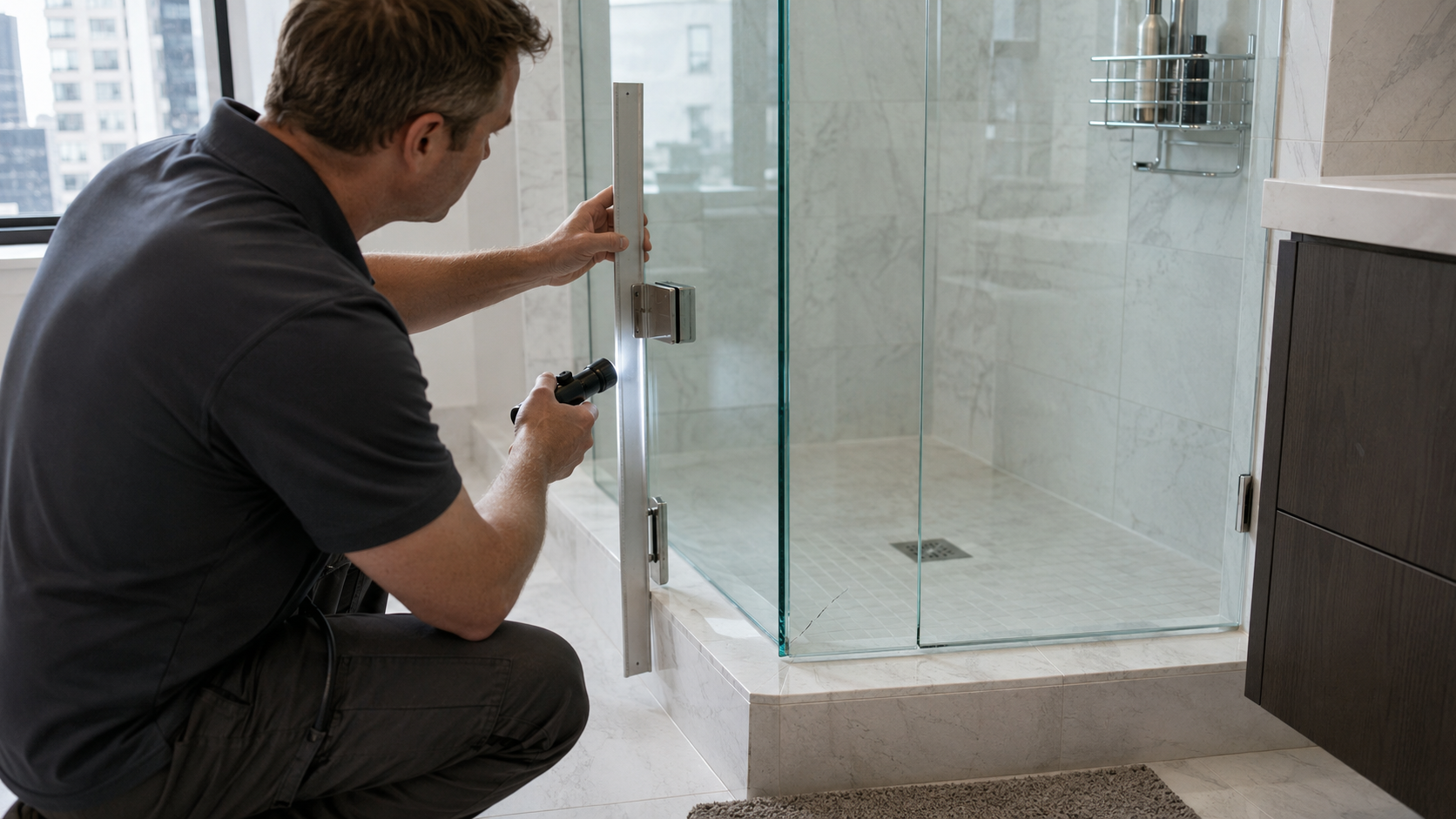
The honest answer usually needs a set of experienced eyes, not a guess from across the bathroom. If you’re not sure whether what you’re looking at is dirt or damage, that uncertainty is itself the answer — it’s worth having someone who works with frameless shower enclosures every day take a look before a small problem quietly becomes a large one. And if it turns out the panel does need replacing, knowing what goes into a custom shower door makes the next decision a lot easier.
Glass keeps a record of how it’s treated. Look after it consistently, catch the small things early, and it does the one thing a good shower enclosure is supposed to do — disappear, and let the room keep all the light.