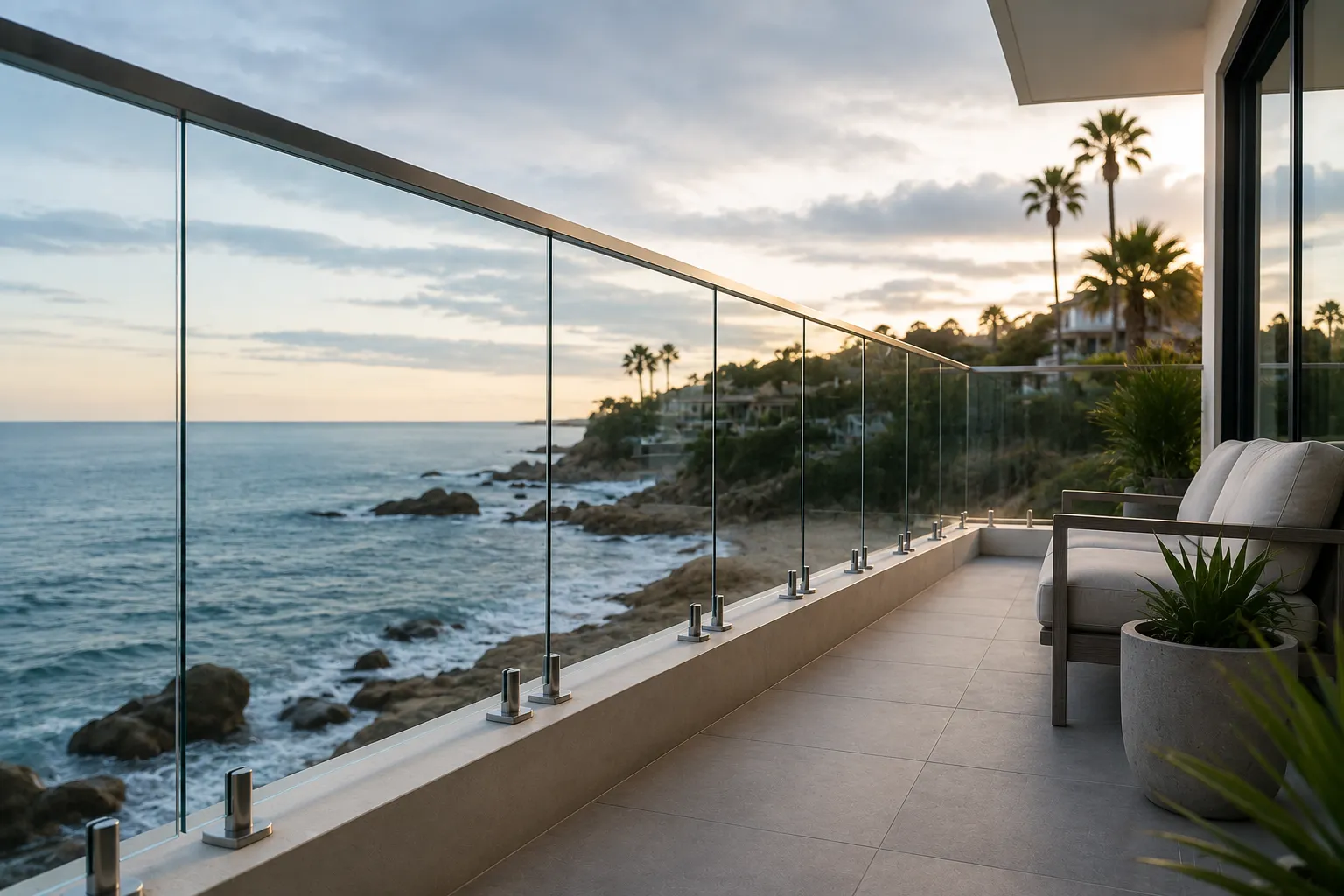
Glass railings look incredible outside.
Balcony. Rooftop deck. Pool area. Shore house. All clean lines and open views.
Then the practical question shows up. Can that glass actually survive NJ weather? Winter freezes, summer storms, wind, salt air near the Jersey Shore or harbor?
Yes, it can.
But only when the system is built for outdoor exposure. The glass matters, of course. Tempered and laminated glass are made to handle weather. Still, most outdoor railing problems are not glass problems. They are hardware problems. Wrong metal. Weak anchors. Bad sealing. Cheap fittings that start rusting before the view even gets old.
That is where outdoor glass railing weather performance is really decided.
Key Takeaways
- The glass rarely fails outdoors. Hardware and anchors are usually the weak spots.
- Salt air near the coast needs 316 marine-grade stainless steel or equivalent.
- Tempered and laminated glass handle UV, wind, rain, and temperature swings without breaking down.
How Glass Handles Weather, UV, and Temperature Swings
Glass is not like wood, vinyl, or painted metal.
It does not rot. It does not warp. It does not absorb water. It does not fade in the sun. UV exposure does not slowly eat it away.
Good start.
Tempered glass is heat-treated, which makes it much stronger than regular glass. Laminated glass adds another layer of safety because it has an interlayer between glass panels. If the glass breaks, the interlayer helps hold pieces together.
For elevated decks, balconies, rooftops, and outdoor stairs, laminated safety glass is usually the better conversation. Not because regular tempered glass cannot handle weather, but because outdoor railings are a safety barrier. If people are leaning on it, walking near it, or standing several feet above grade, you want the safer assembly.
Wind matters too. So does panel size. So does railing height. But the glass itself, when specified correctly, is not the fragile part of the system.
Surprising? Maybe.
True? Yes.
For more detail on tempered and laminated options, see the guide to High-Performance Safety Glass.
The Real Weak Point: Hardware and Corrosion
Here is where outdoor glass railings either last beautifully or become a problem.
The hardware.
Standoffs. Spigots. Base shoes. Clamps. Fasteners. Anchors. All the metal pieces doing the quiet work.
Cheap fittings are especially risky outside. They might look polished on day one. Give them rain, snow, humidity, and salt air, and the truth comes out fast.
There is also galvanic corrosion. Fancy term, annoying problem. It happens when incompatible metals touch each other in the presence of moisture. One metal starts corroding faster. Outdoors, that moisture is always around. Rain. Condensation. Ocean air. Melted snow.
So when people ask about glass deck railing durability, the honest answer is this: the glass can last a very long time, but only if the hardware is chosen with the same seriousness.
Bad hardware makes good glass look bad.
Very quickly.
Salt Air and Coastal Exposure: What Changes Near the Water
Salt air is brutal.
Near the Jersey Shore, harbor, bay, or any waterfront property, corrosion speeds up. Metal that might survive inland can start staining or pitting much faster near salt water.
This is where you cannot use standard indoor-style fittings and hope for the best. Hope is not a hardware spec.
For coastal projects, ask for 316 marine-grade stainless steel or an equivalent outdoor-rated system. Powder-coated aluminum can also work well when it is designed for exterior and coastal use.
The phrase to remember is simple: glass railing salt air corrosion.
That is what you are trying to prevent.
If a contractor cannot clearly explain what metal they are using, what finish it has, and why it works near salt exposure, that is a problem. “Stainless steel” by itself is not enough. There are different grades. Some hold up better outside. Some do not belong anywhere near salty air.
For coastal NJ properties, the best hardware outdoor railing NJ homeowners should ask for is marine-grade, sealed, and properly matched to the site conditions.
Not the cheapest shiny fitting in the catalog.
Anchoring and Installation: Where Most Failures Start
Even the right hardware can fail if it is installed badly.
Annoying, but there it is.
Outdoor railings deal with water all the time. If anchor points are not sealed properly, water can work its way into the substrate. Then winter arrives. Water freezes. It expands. Small movement starts. Over time, that can loosen anchors or damage the surrounding material.
Concrete and wood decks behave differently too. Concrete needs proper drilling, sealing, and anchoring. Wood decks need solid structure underneath, not just surface boards that look sturdy from above.
A railing is only as strong as what it is attached to.
This is why installation makes such a big difference. Done correctly, an outdoor glass railing can last for decades. Done cheaply, it may start showing issues in a few years.
Five years or twenty-five years can come down to details nobody notices on installation day.
Anchor placement. Drainage. Sealant. Substrate condition. Fastener type.
Boring details.
Expensive if ignored.
Choosing Outdoor-Rated Glass Railings That Last
If you want a glass railing that holds up outside, do not shop by looks alone. Every system looks clean in a photo.
Ask what it is made of.
Use this quick spec checklist:
- Laminated safety glass for elevated areas
- Tempered glass where appropriate
- 316 marine-grade stainless near salt water
- Outdoor-rated powder-coated aluminum when suitable
- Sealed anchors
- Compatible fasteners
- Proper drainage around base shoes
- Substrate inspection before installation
- Local code-compliant height and spacing
- Professional installation
Code matters, yes. Railing height, load requirements, glass type, and openings all need to be handled correctly. But the article does not need to become a code lecture.
The simple version: outdoor glass railings should be beautiful, safe, and built for the site they are going on.
Book an outdoor railing site assessment before choosing the system. That is where a pro can check wind exposure, salt conditions, anchoring surfaces, drainage, and the right hardware package.
Much better than guessing.
Keeping Outdoor Glass Railings Durable Long-Term
Outdoor glass railings can absolutely hold up in NJ weather.
The glass is usually not the issue. Tempered and laminated panels can handle sun, rain, snow, wind, and temperature swings. The real question is whether the hardware, anchors, and installation are built for the same conditions.
If you are planning a new railing, ask for a free durability-focused consultation. Especially near the water. The right team can recommend laminated safety glass, 316 stainless steel, marine-grade aluminum, sealed anchors, and the installation details that keep the railing solid for years.
The view should be the dramatic part.
Not the maintenance.