The price difference can be jarring.
A shower door kit at a big-box store may cost a fraction of a custom frameless enclosure. At first glance, both appear to do the same job: put glass around a shower and keep water off the floor.
So where is the extra money going?
Mostly into everything the shelf price leaves out. Accurate measurements. Glass made for one specific opening. Heavier hardware. Installation by people who know what happens when a wall is not quite straight, which, honestly, is often.
Prefab kits can still work well. Custom glass is not automatically the smarter purchase. The bathroom gets the final vote.
Key Takeaways
- Retail kits work best in standard openings with straight walls and level surfaces.
- Custom doors are measured and fabricated for one shower, which usually gives them a cleaner fit.
- Thicker glass, stronger hardware, precision work, and installation drive up the price.
- A cheap door stops being cheap when it does not fit.
- The best option depends on the room, how long the renovation needs to last, and how much compromise you can live with.
Store-Bought Shower Door Kits: What You Actually Get
Retail shower door kits are mass-produced in common widths and heights.
That is how the price stays low. The manufacturer makes thousands of nearly identical units instead of building one enclosure for one bathroom.
Most kits offer some adjustment. A frame or wall channel may expand across a small range, giving the installer room to deal with minor differences in width.
Minor is the important word there.
These kits often include:
- thinner glass;
- aluminum framing or wide adjustment channels;
- basic handles and rollers;
- simplified hardware;
- instructions written with DIY installation in mind.
And sometimes that is completely fine.
A newer home with a standard alcove shower, level curb, and reasonably straight walls may take a prefab door without much drama. Plenty of homeowners install them successfully and get years of use.
The trouble starts when the room is not as standard as the box expects.
| Feature | Store-Bought Kit | Custom Frameless Door |
|---|---|---|
| Sizing | Standard ranges | Made for the exact opening |
| Glass | Usually thinner | Often thicker tempered glass |
| Hardware | Basic, mass-produced | Chosen for the layout and glass weight |
| Fit | Adjusted with frames or channels | Fabricated around actual walls and angles |
| Installation | DIY-friendly | Usually professionally installed |
| Upfront cost | Lower | Higher |
| Design flexibility | Limited | High |
Why Custom Shower Doors Cost More
A custom enclosure does not exist before somebody measures your bathroom.
That alone changes the process.
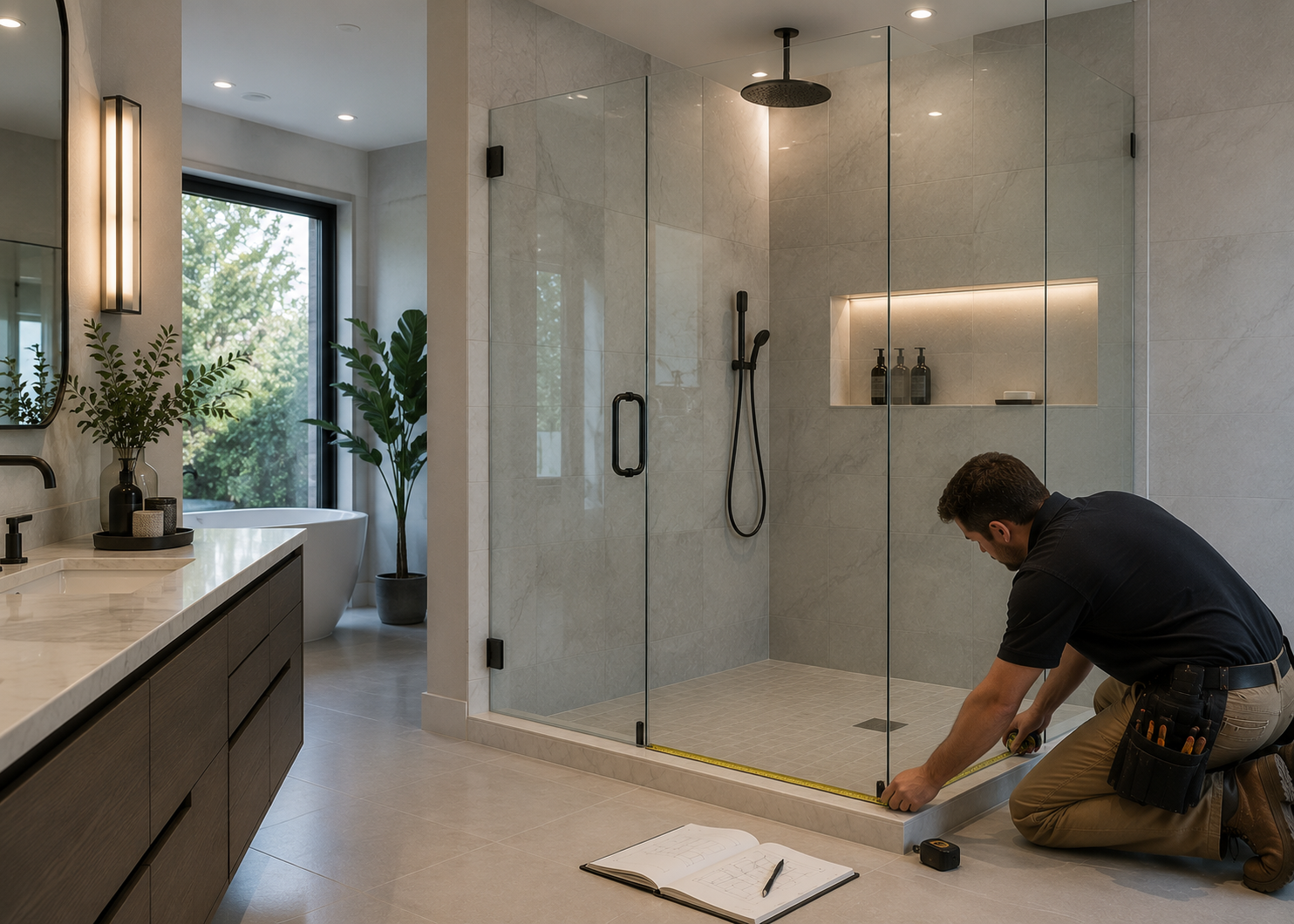
A technician checks the opening at several points because the width at the top may not match the width at the bottom. They look at wall angles, curb slope, tile variation, door clearance, and where the hardware can safely attach.
Then the glass is made from those measurements.
Not pulled from a warehouse. Made.
The panel may need custom edges, hinge cutouts, handle holes, angled sections, or notches around benches and walls. All of that happens before tempering because tempered glass cannot be cut later.
Get the shape wrong and there is no quick trim on installation day.
There is just a new panel.
Custom systems also tend to use thicker glass. That adds weight, which means the hinges, clamps, and anchors need to be strong enough to support it. Better hardware costs more, and so does installing it correctly.
You are also paying for somebody to take responsibility for the fit.
With a retail kit, the manufacturer supplied the product. Whether it works in your bathroom is largely your problem. With a custom enclosure, measuring, fabrication, installation, and adjustments usually sit under one project.
That support has value, even though it is not the exciting part people photograph.
The Hidden Costs Nobody Includes in the First Comparison
The shelf price is only useful when the kit fits.
If it does not, the cheap option can become a small financial comedy.
Maybe the door is the wrong width and has to be returned. Maybe the frame needs extra filler strips. Maybe a contractor has to straighten a wall, rebuild part of the curb, or move hardware because the standard layout collides with the vanity.
Then there are installation mistakes.
A slightly crooked track may make the door drag. Weak hardware may need replacing sooner than expected. Poor sealing can leave you wiping up water after every shower, which becomes less charming by day three.
Other costs may include:
- extra trim and wall channels;
- professional help after a failed DIY installation;
- replacement rollers or handles;
- wall repairs;
- delivery and return fees;
- replacing the whole enclosure earlier than planned.
A prefab kit can still be the economical choice. It just needs to work without the bathroom being rebuilt around it.
Which Bathrooms Benefit Most From Custom Glass?
Some rooms practically announce that a standard kit is going to struggle.
Older NYC homes are a good example. Walls settle. Floors slope. Tile follows old plaster that was never perfectly flat to begin with.
Bronx apartments, brownstones, and pre-war bathrooms often have openings that are close to standard but not close enough. The right door style for a small Bronx layout can make a real difference here.
Custom glass is usually worth considering when the bathroom has:
- uneven or leaning walls;
- an opening that is not square;
- an oversized shower;
- a neo-angle or corner layout;
- a walk-in design with fixed splash panels;
- a bench, half-wall, or unusual ceiling line;
- limited clearance around the toilet or vanity.
This is not always about making the bathroom look expensive.
Sometimes custom is simply the only way to make the door fit without covering every uneven edge in metal.
Is a Custom Shower Door Worth the Investment?
That depends on how long you need the bathroom to work.
For homeowners planning to stay for many years, custom glass often makes more sense. Stronger hardware, a better fit, fewer tracks, and fewer replaceable plastic parts can mean less irritation over time.
Frameless systems are also easier to clean in one obvious way: there are fewer bulky channels collecting soap and grime.
Fewer little grooves. A gift, honestly.
The cleaner appearance may help with resale too. Buyers tend to notice a large frameless shower because it makes the room feel more open and finished. That does not mean the door will return every dollar spent, but it can improve the way the whole bathroom is perceived.
If the property is being sold soon, the decision becomes more practical.
A custom enclosure may be worthwhile in a higher-end renovation where a basic kit would look out of place. In a modest rental or quick refresh, it may be more money than the project needs.
When a Store-Bought Kit Still Makes Sense
Custom glass is not the correct answer every time.
A prefab kit may be the better choice when:
- the opening is a common size;
- the walls and curb are straight;
- the renovation is temporary;
- the property is a rental;
- the budget is tight;
- the homeowner is comfortable handling installation.
A framed kit can also hide small wall variations better than fully frameless glass. That is not as sleek, but sleek is not everybody’s first priority.
Sometimes the sensible answer is the $600 kit that fits, installs cleanly, and does its job.
No need to turn every bathroom into a design statement.
The Better Value Depends on the Room
Custom frameless doors cost more because they involve more work, more precise materials, and more responsibility from the contractor.
Retail kits cost less because they are standardized.
Neither fact makes one option automatically better.
If the bathroom is straight, standard, and simple, a store-bought kit may be all you need. If the walls lean, the opening is unusual, or the enclosure needs to last through years of daily use, custom glass may save trouble later.
The cheapest purchase is not always the cheapest project.
And the most expensive option is not always necessary.
Not Sure Which Option Fits?
Amber Glass can measure your shower opening, explain whether a standard solution is realistic, and provide transparent pricing for a custom enclosure.
That way, you can compare both options before spending money on the wrong one.
Request a Free Estimate for a fully custom frameless enclosure.